
 Goddess Lakshmi
Lakshmi:

Lakshmi is the Hindu Goddess consort of Lord Vishnu (Venkatesa). She Governs All form of Wealth and Success and the Paths, Means and Results of all forms of Prosperity.
She is the Goddess of Health , Beauty, Siddhi, Peace, Strength, Balance, Auspiciousness, Opulence and Wisdom.
She brings good luck, especially in business.
She in the form of Pthmavathy did thapas, sitting on a large and beautiful Lotus flower in Padmawathy Knuru. She got married to Lord Venkatesa (Vishnu).
 Padmavathi Konaru (Laksmi Tank)
She blesses the devotees with all prosperity.
Here is ‘Sri Venkatesa Prapatti’, a prayer song praising her and Sri Venkatesa Perumal. English translation is given for every verse.
Here is ‘Sri Venkatesa Prapatti’, a prayer song praising her and Sri Venkatesa Perumal. English translation is given for every verse.

Sri Laksmi Sthuthi Sri Venkatesa Prapatti

isanam jagato ‘sya venkatapater visnoh param preyasim tad-vaksassthala-nityavasa rasikam tatsantisamvardhinim, padmalankrta-panipallava-yugam padmasanastham sriyamvatsalyadi-gunojjyalam bhagavatim
vande jaganmataram.
vande jaganmataram.
I salute Goddess Lakshmi, who is the Queen of the Universe, who is the most beloved of Vishnu, the Lord of Venkatachala, who is fond of dwelling on His (Vishnu’s) chest, who is the promoter of His forgiving nature, who has hands decorated with lotuses, who is seated on a lotus in the posture of a lotus (called padmasana), who shines with virtues like mercy and who is the Mother of the Universe.
sriman!krpa-jalanidhe!krta-sarvaloka! sarvajna! sakta! nata-vatsala! sarvasesin, svamin!susila-sulabhasrita parijata!
sri-venkatesa! charanau saranam prapadye.
sri-venkatesa! charanau saranam prapadye.
One who possesses Sri (wealth)! Ocean of Compassion! Creator of the whole Universe! The Omniscient! The Almighty! Affectionate to those that bow to Thee! The Principal of the animate and inanimate world! Easily attainable by persons of good conduct! the Divine tree (parijata) to those who seek refuge! Venkatesa! I stay at Thy feet.
anupurarpita-sujata-sugandhi-puspa-
saurabhya-saurabha-karausama-sannivesau,
saumyau sadanubhavane‘pi navanu-bhavyau
sri-venkatesa-charanau saranam prapadye.
I seek refuge at Venkatesa’s feet which add fragrance to the scent of the sweet-smelling flowers which decorate His feet up to His anklets, which are well-placed and handsome, which are always enjoyable even though they are ever seen.
saurabhya-saurabha-karausama-sannivesau,
saumyau sadanubhavane‘pi navanu-bhavyau
sri-venkatesa-charanau saranam prapadye.
I seek refuge at Venkatesa’s feet which add fragrance to the scent of the sweet-smelling flowers which decorate His feet up to His anklets, which are well-placed and handsome, which are always enjoyable even though they are ever seen.
sadyo-vikasi-samuditvara-sandraraga- saurabhya-nirbhara-saroruha-samya-vartam,
samyaksu sahasa-padesu vilekhayantau
sri-venkatesa-charanau saranam prapadye.
I seek refuge at Sri Venkatesa’s feet, and it induces us to compare His beautiful feet with lotuses that have just blossomed and emanate fragrance and red color. This comparison is hasty and not right as the feet of the Lord are several times superior to lotuses.
samyaksu sahasa-padesu vilekhayantau
sri-venkatesa-charanau saranam prapadye.
I seek refuge at Sri Venkatesa’s feet, and it induces us to compare His beautiful feet with lotuses that have just blossomed and emanate fragrance and red color. This comparison is hasty and not right as the feet of the Lord are several times superior to lotuses.
rekhamaya-dhvaja sudha-kalasatapatra- vajrankusamburuha-kalpaka-sankha-chakraih,
bhavyair alankrta-talau paratattva-chihnaih
sri-venkatesa charanau saranam prapadye.
I seek refuge at Venkatesa’s feet whose soles bear marks of the Supreme Spirit like the Banner, Pot of Ambrosia, Umbrella, Thunderbolt, Lotus, Divine Tree (Kalpa vrksa), Conch and the Disc which can be seen in the form of auspicious lines.
bhavyair alankrta-talau paratattva-chihnaih
sri-venkatesa charanau saranam prapadye.
I seek refuge at Venkatesa’s feet whose soles bear marks of the Supreme Spirit like the Banner, Pot of Ambrosia, Umbrella, Thunderbolt, Lotus, Divine Tree (Kalpa vrksa), Conch and the Disc which can be seen in the form of auspicious lines.
tamrodara-dyuti-parajita-padmaragau
bahyair mahobhir abhibhuta-mahendra-nilau, udyan-nakhamsubhir-udasta-sasanka-bhasau
sri-venkatesa-charanau saranam prapadye.
I seek refuge at Venkatesa’s feet whose reddish soles surpass the luster of rubies (called Padmaraga) or red lotuses; whose appearance excels the brilliance of sapphires (called Indranila) and whose toe-nails outshine moonlight.
bahyair mahobhir abhibhuta-mahendra-nilau, udyan-nakhamsubhir-udasta-sasanka-bhasau
sri-venkatesa-charanau saranam prapadye.
I seek refuge at Venkatesa’s feet whose reddish soles surpass the luster of rubies (called Padmaraga) or red lotuses; whose appearance excels the brilliance of sapphires (called Indranila) and whose toe-nails outshine moonlight.
suprema-bhiti kamala-karapallavabhyam samvahane’pi sapadi klamam adadhanau, kantay avan-manasa-gochara-saukumaryau
sri venkatesa-charanau saranam prapadye.
I seek refuge at Venkatesa’s feet which, though massaged with love and apprehension by the hands of Lakshmi, are experiencing fatigue, and are yet very charming, the tenderness of which is not within the scope of speech or mind.
sri venkatesa-charanau saranam prapadye.
I seek refuge at Venkatesa’s feet which, though massaged with love and apprehension by the hands of Lakshmi, are experiencing fatigue, and are yet very charming, the tenderness of which is not within the scope of speech or mind.
laksmi-mahi-tadanurupa-nijanubhava-
niladi-divya-mahisi-kara-pallavanam,
arunya-sankramanatah kila sandraragau
sri venkatesa charanau saranam prapadye.
I seek refuge at Venkatesa’s feet which have become extremely red on account of the union with the redness of the hands of the Divine queens like Sridevi, Bhudevi and Niladevi.
niladi-divya-mahisi-kara-pallavanam,
arunya-sankramanatah kila sandraragau
sri venkatesa charanau saranam prapadye.
I seek refuge at Venkatesa’s feet which have become extremely red on account of the union with the redness of the hands of the Divine queens like Sridevi, Bhudevi and Niladevi.
nityanamad-vidhi-siadi-kiritakoti-
pratyupta-dipta-navaratna-mahah-prarohaih, nirajanavidhim udaramupadadhanau
sri-venkatesa-charanau saranam prapadye.
I seek refuge at Venkatesa’s feet which receives as it were, the grand nirajana (harati), through the luster of the nine gems studded on the crowns of Brahma, Siva and others who bow their heads every day before Him.
pratyupta-dipta-navaratna-mahah-prarohaih, nirajanavidhim udaramupadadhanau
sri-venkatesa-charanau saranam prapadye.
I seek refuge at Venkatesa’s feet which receives as it were, the grand nirajana (harati), through the luster of the nine gems studded on the crowns of Brahma, Siva and others who bow their heads every day before Him.
visnoh pade parama ity udita-prasamsau yau madhva utsa iti bhogyatayapy upattau, bhuyas tatheti tava panitala-pradistau
sri venkatesa! charanau sarnam prapadye.
Venkatesa! I seek refuge at Thy feet which are extolled (in the Rig Veda I.154.5) as 'Vishnu parame pade' (meaning 'in the most exalted abode of Vishnu); as 'madhava utsah' (meaning ‘the fountain of honey’); as extremely enjoyable; and which are indicated as such by the direction in which Thy palm points.
sri venkatesa! charanau sarnam prapadye.
Venkatesa! I seek refuge at Thy feet which are extolled (in the Rig Veda I.154.5) as 'Vishnu parame pade' (meaning 'in the most exalted abode of Vishnu); as 'madhava utsah' (meaning ‘the fountain of honey’); as extremely enjoyable; and which are indicated as such by the direction in which Thy palm points.
parthaya tatsadrsa-sarathina tvayaiva
yau darsitau svacharanau sarnam vrajeti, bhuyo’pi mahyam iha tau karadarsitau te
sri-venkatesa! charanau sarnam prapadye.
Venkatesa! I seek refuge at Thy feet which were shown (in your incarnation as Krishna) to the worthy charioteer, Arjuna, for him to seek refuge, and which, now on Venkatadri, are again pointed out by Thy hand for me to seek refuge.
yau darsitau svacharanau sarnam vrajeti, bhuyo’pi mahyam iha tau karadarsitau te
sri-venkatesa! charanau sarnam prapadye.
Venkatesa! I seek refuge at Thy feet which were shown (in your incarnation as Krishna) to the worthy charioteer, Arjuna, for him to seek refuge, and which, now on Venkatadri, are again pointed out by Thy hand for me to seek refuge.
manmurdhni kaliyaphane vikatatavisu
sri-venkatadri-sikhare sirasi srutinam,
chittepy ananya-manasam samam ahitau te
sri-venkatesa! charanau saranam prapadye
Venkatesa! I seek refuge at Thy feet which are placed in the same way: on my sinner's head, on the hood of the serpent Kaliya, in the thick forests, on the peak of Venkatachala, in the Upanishads and in the hearts of the sages who meditate on God. (It means Venkatesa is omnipresent).
sri-venkatadri-sikhare sirasi srutinam,
chittepy ananya-manasam samam ahitau te
sri-venkatesa! charanau saranam prapadye
Venkatesa! I seek refuge at Thy feet which are placed in the same way: on my sinner's head, on the hood of the serpent Kaliya, in the thick forests, on the peak of Venkatachala, in the Upanishads and in the hearts of the sages who meditate on God. (It means Venkatesa is omnipresent).
amlana-hrsyad-avanitala-kirna-puspau
sri-venkatdri-sikharabharanayamanau,
ananditakhila-mano-nayanau-tavaitau
sri-venkatesa! charanau saranam prapadye.
Venkatesa! I seek refuge at Thy feet around which the scattered flowers remain fresh. Thy feet which are an ornament of Venkatachala, delight the hearts and eyes of all.
sri-venkatdri-sikharabharanayamanau,
ananditakhila-mano-nayanau-tavaitau
sri-venkatesa! charanau saranam prapadye.
Venkatesa! I seek refuge at Thy feet around which the scattered flowers remain fresh. Thy feet which are an ornament of Venkatachala, delight the hearts and eyes of all.
prayahprapanna-janata-prathamavagahyau
matuh stanaviva sisor mrtayamanau, praptau paraspara-tulam atulantarau te sri-venkatesa! charanau saranam prapadye.
Venkatesa! I seek refuge at Thy feet which are to be seen at first by people who pay obeisance to them often; which are nectar like mother's milk to her child; which can be compared with each other, but incomparable with anything else.
matuh stanaviva sisor mrtayamanau, praptau paraspara-tulam atulantarau te sri-venkatesa! charanau saranam prapadye.
Venkatesa! I seek refuge at Thy feet which are to be seen at first by people who pay obeisance to them often; which are nectar like mother's milk to her child; which can be compared with each other, but incomparable with anything else.
satvottarais-satata-sevya-padambujena
samsara-taraka-dayardra-drganchalena,
saumyopayantr-munina mama darsitau te
sri-venkatesa! charanau saranam prapadye
Venkatesa! I seek refuge at Thy feet which are shown to me by the sage Manavala, the sage whose feet are always worshiped by Sattvic people (men of sattva guna) and whose mind and merciful glances enable mankind to cross the ocean of transmigration (samsara).
samsara-taraka-dayardra-drganchalena,
saumyopayantr-munina mama darsitau te
sri-venkatesa! charanau saranam prapadye
Venkatesa! I seek refuge at Thy feet which are shown to me by the sage Manavala, the sage whose feet are always worshiped by Sattvic people (men of sattva guna) and whose mind and merciful glances enable mankind to cross the ocean of transmigration (samsara).
srisa! sriya ghatikaya tvadupayabhave
prapye tvayi svayam upeyatavasphurantya,
nityasritaya niravadya-gunaya tubhyam
syam kinakaro vrsagirisa! na jatu mahyam.
Srinivasa! When Thou art a means i.e., upaya (to the devotees for attainment of the Supreme Abode, i.e. Liberation), Lakshmi brings about this. When Thou become the object of attainment (prapya), Lakshmi appears to be so resorting to Thee always. Thou art of pure faultless qualities. I become servant to Thee and not to myself at any time.
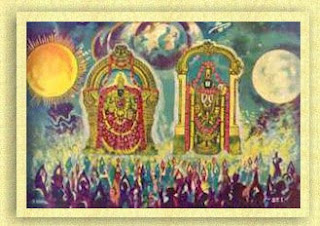 Thirupathi Venkatesa Perumal With Padmavathi (Lakshmi)
prapye tvayi svayam upeyatavasphurantya,
nityasritaya niravadya-gunaya tubhyam
syam kinakaro vrsagirisa! na jatu mahyam.
Srinivasa! When Thou art a means i.e., upaya (to the devotees for attainment of the Supreme Abode, i.e. Liberation), Lakshmi brings about this. When Thou become the object of attainment (prapya), Lakshmi appears to be so resorting to Thee always. Thou art of pure faultless qualities. I become servant to Thee and not to myself at any time.
 Thirupathi Venkatesa Perumal With Padmavathi (Lakshmi)


